
 |
| People |
Population :
|
27,544,305 (July 2004 est.) |
| Languages : |
Spanish (official), Quechua (official), Aymara, and a large number of minor Amazonian languages |
| Age Structure: |
0-14 years: 32.1%
15-64 years: 62.8%
65 years and over: 5.1% |
| Economy |
Currency :
|
nuevo sol (PEN) - 3.4785 to $1US (2003) |
| Industries : |
mining of metals, petroleum, fishing, textiles, clothing, food processing, cement, auto assembly, steel, shipbuilding, metal fabrication |
| Below Poverty : |
54% (2003 est.) |
| Government |
Capital :
|
Lima |
| Type of Gov’t : |
constitutional republic |
| President : |
Alejandro
Toledo Manrique
(since 28 July 2001) |
| Independence : |
28 July 1821 (from Spain) |
| Geography |
Climate :
|
varies from tropical in east to dry desert in west; temperate to frigid in Andes |
| Terrain : |
western coastal plain (costa), high and rugged Andes in center (sierra), eastern lowland jungle of Amazon Basin (selva) |
| Nat. Resources : |
copper, silver, gold, petroleum, timber, fish, iron ore, coal, phosphate, potash, hydropower, natural gas |
| Background |
| |
Ancient
Peru was the seat of several prominent Andean civilizations,
most notably that of the Incas whose empire was
captured by the Spanish conquistadores in 1533.
Peruvian independence was declared in 1821,
and remaining Spanish forces defeated in 1824.
After a dozen years of military rule, Peru returned
to democratic leadership in 1980, but experienced
economic problems and the growth of a violent insurgency.
President Alberto Fujimori's election in
1990 ushered in a decade that saw a dramatic turnaround
in the economy and significant progress in curtailing
guerrilla activity. Nevertheless, the president's
increasing reliance on authoritarian measures and
an economic slump in the late 1990s generated mounting
dissatisfaction with his regime. Fujimori won reelection
to a third term in the spring of 2000, but international
pressure and corruption scandals led to his ouster
by Congress in November of that year. A caretaker
government oversaw new elections in the spring of
2001, which ushered in Alejandro Toledo as the new
head of government. |
| Further Information |
| These facts have come from The World Factbook online. For more information on Peru, visit them here |
|
 |
|
 |
|
Mision Santiago
“El Comercio”
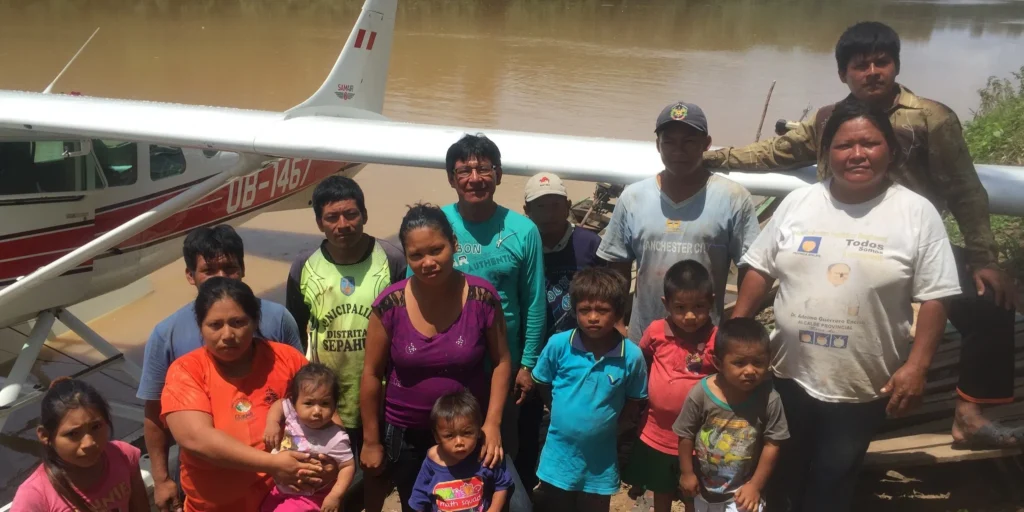
New SAM Plane
Ashaninca Bible Institute
Motociclistas para Cristo
Earthquake
Opportunities to Serve in Peru
Spring in Arequipa, Peru
What’s Going On In Pucallpa, Peru?
Movement in the Jungle
Observations By a First-year Teacher at SAM Academy
From Winterport, Maine to Peru
|
 |
 |
| This
would be the featured article of most recent happenings
in Peru and would be related to picture above (continue)... |
|
 |
Peru work begun: 1921
Peru has a
rich history as the center of the Inca Empire and the
focal point of the Spanish thirst for gold. More than
five centuies after the arrival of the Conquistadores,
this Andean country still stuggles for an identity between
the old and new worlds.
The first
South America Mission missionaries entered the country
by way of the Amazon in 1921. Progressing slowly up
the Amazon, Ucayali, and Pachitea Rivers, an outreach
was established among the Campa Indians.
Today, SAM
Peru is involved in a wide variety of ministries, committed
to the growth of the indigenous Church by equipping
and empowering men and women to reach their own coutrymen
in fulfillment of the Great Commission. This initiative
is based out of the jungle towns of Pucallpa, Satipo
and Iquitos, and is accomplished through evangelism,
discipleship and church planting, with an emphasis on
leadership formation through strategically located institutes.
Present Ministries/Needs:
Jungle Evangelism/Discipleship, Maintenance & Discipleship,
MK Education, Pastoral Training Director's Assistant,
TESL Teacher
|
 |
|
 |
|
 |
|